Showing posts with label cheese. Show all posts

Thursday, 26 December 2013

Christmas leftovers... some ideas

So, hands up who bought too much food for one? I manage this every year, always with the mindset that friends might drop by or I might have an unexpected dinner guest on Christmas Night who has nowhere else to go. At the moment I'm looking at a large slab of belly pork on a plate in my fridge - some of that will be simply reheated for dinner tonight, accompanied by some of a lovely savoy cabbage I have and the rest of yesterday's roast parsnips.

If you're stuck for ideas, here's a few.
The quick chicken supreme work well with other poultry such as turkey, if you bought a small crown, guinea fowl or duck. And so will my cheat's chicken cacciatore - just make the sauce without the uncooked chicken, then add the cooked meat 10 minutes before the end, so it's thoroughly reheated.

Pie and risotto will take almost any filling - both are a good way to use up whatever leftover meat and vegetables you have to hand. Try my chicken and vegetable pie or chicken risotto.

My recipe for lamb in date and lemon sauce says uncooked lamb, but cooked will be fine - you'll be basically reheating it in the sauce in the oven. You can do the same with my fruity goat tagine - it doesn't have to be goat meat: leftover lamb or chicken will both be fine. A couple of slices of cooked lamb can also substitute for fresh chops in my lamb chops baked in the oven.

Soup is a go-to for Christmas leftovers. My game soup is ideal for leftover partridge, pheasant or other roast birds. My quick winter minestrone is very adaptable - the tomatoes, greens and pasta are the backbone, then just throw whatever else you have to hand in it.

If you have too many root vegetables lurking in your fridge, the winter root veg casserole is tasty and also simple and light after the richer food of Christmas Day.

If you have leftover cheese, you could make yourself a thrifty cheesecake or use some up in a stilton, rosemary and walnut scone.

Don't forget, quite a few of these can also be frozen once made - handy for those days when you don't feel like cooking but can pull something home-cooked from the freezer!

Friday, 20 December 2013

Christmas dinner for one - 2013

Christmas dinner for one - time for a revisit. I offered some suggestions exactly two years ago, but it never hurts to look at some more options. (This topic is one of the main searches that brings you readers to my blog, all year round!)

Apart from the alternatives to turkey I suggested last time, a spatchcocked poussin will feed one very hungry person, or give you a meal and a bit for leftovers (using the carcass to make stock afterwards, for soup or risotto). You can spatchcock the bird yourself if you have a pair of poultry shears or very sharp kitchen scissors - it's very easy. If not, ask the butcher to do it for you. The supermarkets have them at this time of year, already prepared. All you need to do is oil the skin, add a rub if you like and roast for about 40 minutes at 180C. (I cooked the one above with a rub made of sweet smoked paprika and ate it with a plate of oven chips.)

I wrote about breast of lamb in October - it's cheapish, very tasty and very versatile. I stuffed the one in the photo a couple of weeks ago, with a homemade stuffing of breadcrumbs, a handful of chopped chestnuts, a few dried apricots and a little rosemary - very seasonal. If you opt for this, the October post has cooking instructions.

I can also recommend (again) looking in the freezers in Lidl and Aldi. I've already picked up a cooked, frozen lobster for £6 from Lidl, as I do every year, and both shops have a good selection of small three-bird roasts that will give you 2-3 portions - enough for Christmas Day, plus leftovers for sandwiches, curry, a casserole of some sort, a pie (swap the veg for leftover roast parsnips, carrots or sprouts) or soup.

Fresh ducks should also be appearing now. One duck feeds two people quite well, so you'll have some nice leftovers from that - it makes a good stir-fry if you cheat, like I do, with some bought stir-fry sauce.

What am I having? I don't know yet, is the short answer. I have a nice slab of Cheshire belly pork in my freezer but I'm also tempted to buy either a duck or a rack of lamb next week. A rack of lamb is quick and easy to cook, and cobbling together a quick crust of breadcrumbs and herbs adds extra flavour (I had this last year). These should be in the supermarkets from about now but you should also be able to order one from a butcher - a rack of 3-4 chops should be enough and you can make a pilaf (watch this space) if you can't finish it in one go.

If you have any questions, do post in the comments below and I'll do my best to answer.

Merry Xmas!

Wednesday, 23 October 2013

Thrifty cheesecake

This is a great way to use up bits and pieces from the fridge and larder to make a small dessert. I started making this after I froze a spare packet of cream cheese and when I defrosted much later, I discovered it had split. I hate throwing food away so had to think up ways to use it up. This makes enough for two individual cheesecakes - perfect for when you want something sweet but just a small taste of it.

What you need:
1/2 packet of soft cheese, such as Philadelphia 
A level dsp of icing sugar
1 tsp vanilla essence
1 tsp lemon essence
2-3 plain hobnobs or other biscuits
A small knob of butter

What to do:
Put the biscuits in a paper bag and crush them with a rolling pin. Melt the butter in a small bowl set over a pan of simmering water. Add the biscuit crumbs and mix well. Spoon the mixture into two small ramekins and press it down well to make a firm base. Pop the ramekins in the fridge. 

Put the cheese and sugar into a bowl and mix well. Taste to check the balance of flavours - you want to be able to taste the cheese and it shouldn't be too sweet. Add the two essences and mix well. Spoon it over the bases, pressing it in and smoothing the top, and put back in the fridge. Leave for a good hour to set firmly. 

Cook's tips:
How much biscuit and butter you need will depend on the size of your ramekins. I find2.5 is about right to make a base of about half a centimetre deep. You need just enough butter to coat the crumbs so they'll stick together, but not so much they set rock hard in the fridge - the base should hold together but still be crumble. About a teaspoon should be about right.

I use the bowl over hot water as the amount of butter is too small to melt directly in the pan and tends to just dissipate across the surface without coating the crumbs.

For a slightly posher version, omit the essences and substitute a little grated lemon zest and some seeds from a vanilla pod.

Wednesday, 5 December 2012

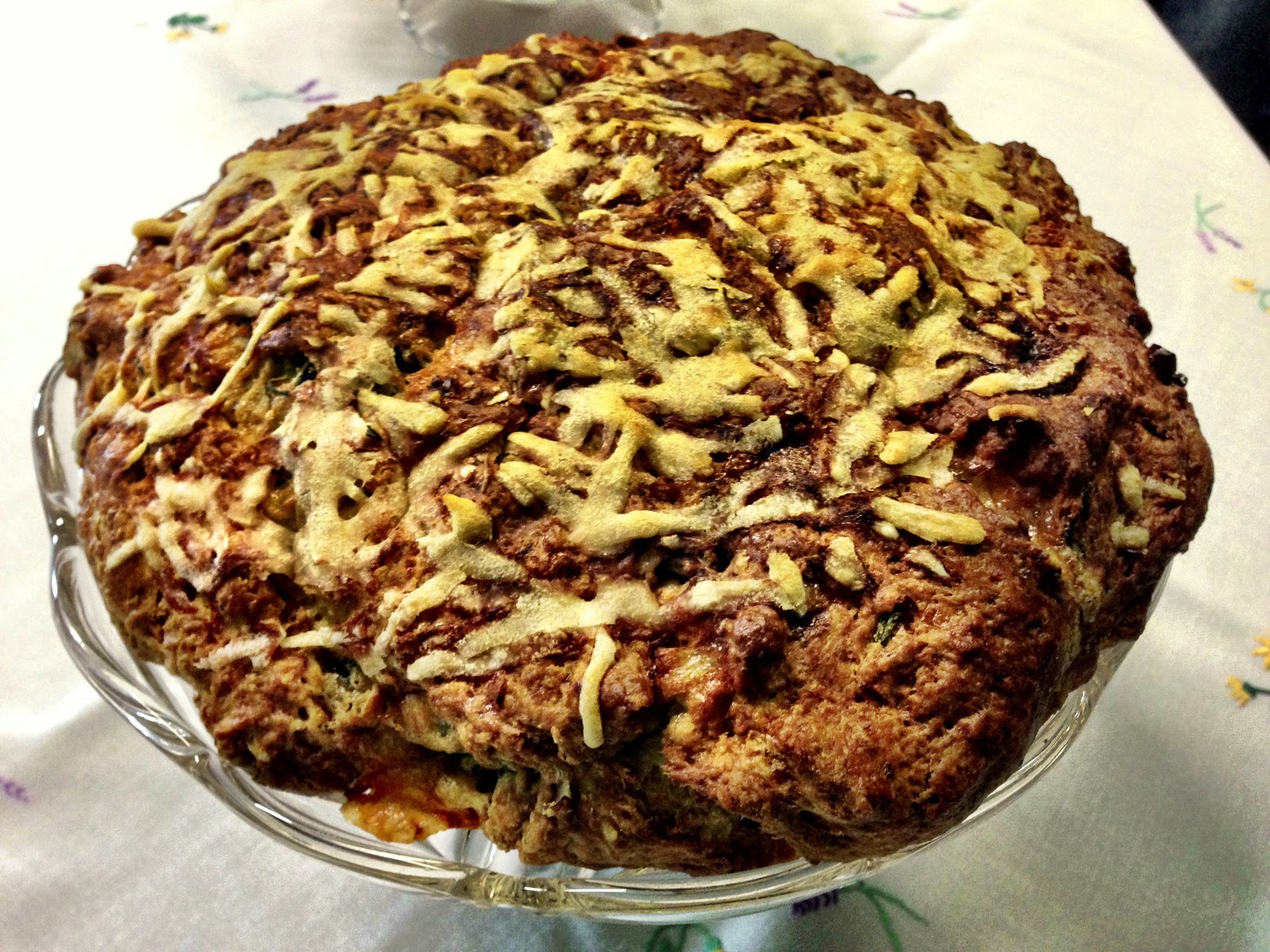
Stilton, rosemary and walnut scone

This almost-cakey slab of savoury carbs is really easy to knock up and the kind of thing I'm likely to bake when I need a supply of snacky stuff to nibble on when I'm working, or as the basis for a lazy supper on a tray in front of the TV.

What you need:
250g self-raising flour
1/2 tsp bicarbonate of soda
45g cold butter, cut into small chunks
150ml milk or soya milk
150g stilton, cut into cubes
A sprig of rosemary, leaves stripped off and very finely chopped
6-8 walnut halves, chopped
Parmesan cheese

What to do:
Heat the oven to 200C.

Sift the flour and baking powder into a large mixing bowl. Rub the butter into the flour with your fingers - it should look like breadcrumbs. Add the milk and work it in gently until it forms dough. If it is too dry to take up all the flour, add a little more milk. If it's too wet sprinkle in a little more flour. Add the cubes of Stilton, walnut pieces and chopped rosemary. Knead the dough so everything is well distributed.

Line a baking sheet with a piece of baking parchment. Put the scone dough on to it, shape it into a round then flatten it very gently. Score the top into eight and grate a little parmesan over it. Bake for 25 minutes or so - it should be risen and golden.

Cook's tips:
Any blue cheese works really well here - try some gorgonzola or bleu d'Auvergne. Blacksticks Blue is especially tasty here but if you're on a budget a Danish blue is just as good.

I like to tinker with the additions - any good melting cheese can replace the blue. I sometimes add some chopped raw bacon or lardons instead of walnuts. A little very finely diced onion adds a good blast of flavour (sprinkle a little on the top too). Chopped fresh thyme or sage can take the place of rosemary. Sliced black olives also work.

I like to make it in a big round as you can break off as much as you want (keep the rest in a tin or wrapped in foil for later) but you could make individual scones with a cookie cutter - adjust the cooking time to 20 minutes then check on them!

The recipe doubles up really easily, just up the cooking time to 30-35 minutes.

Friday, 30 November 2012

Flammekueche

Flammekueche, street food from Alsace, is probably best described as a Franco-German pizza. You won't find any tomato sauce on it, or olives, peppers or any other traditional pizza topping but it's made in the same way - a very thin dough base topped with ingredients then cooked in a very hot wood-burning oven.

The French region of Alsace has historically changed hands with Germany many times, hence the German-sounding name for this dish. The Germans call it flammkuchen, the French tarte flambée, but the Alsatian name is what it's best known by. A while back I discovered that the discount supermarket Lidl sometimes has flammekueche in its freezer section, usually when it has a French promotion, so it's worth having a look there. If I see them, I snap them up quick!

However, it's ridiculously easy to make at home if you cheat. It's absolutely not worth knocking up a batch of pizza dough for one person but if you can get hold of a good quality, ready-made pizza base you can have food on the table in 15 minutes. All you need after that are the toppings - crème fraiche, onions and bacon.

What you need:
An artisan pizza base
Creme fraiche
A small packet of lardons
A small onion, finely diced
Seasoning

What to do:
Heat the oven to 200-220C - if you have time, get it hot well in advance so the heat really has a chance to build up and stay there.

Put the base on a pizza stone and spread it almost to the edge with the creme fraiche - about 3tbsp should be enough for a 12" base. Scatter over the onion and lardons and grind a little black pepper over. Bake in the oven for about 10 minutes.
Cook's tips:
The base needs to be as thin as possible. Anything from a supermarket will be too thick and doughy. The one I used here came from a farmers' market and was handmade. At less than 1mm thick, it was perfect. Check the cooking instructions on the pack but the temperature and time I gave up should be about right. And of course it will depend on the idiosyncrasies of your oven.

If you're using regular bacon, 2-3 slices of streaky cut into 1mm shreds is a good substitute for the lardons.

A classic flammekueche has just the ingredients listed but variations in Alsace include mushrooms or cheese. If you decide to add cheese, don't use cheddar as it goes too gooey - a French-style hard cheese such as Gruyère works best.

Monday, 1 October 2012

Baked onions

I've had a thing about whole cooked onions ever since I was a child and we ate shepherd's pie for tea with a side order of boiled Spanish onions as the main vegetable. Boiling makes them very soft - if you can find the Spanish variety, which are pretty large, all you need to do is peel them, leaving the root intact, then bring to the boil on the hob and keep them on a medium simmer for about an hour.

However, baking them in their skins really concentrates the flavour and makes them very sweet.

What you need: 
2-3 large whole onions
A little balsamic vinegar
Grated cheese
Seasoning

What to do: 
Make sure you choose onions with several layers of skin on - you don't want any that have just one thin layer peeling off and exposing the white flesh. Give them a wash under the cold tap if they have any mud on them and pat dry with kitchen paper.

Trim the roots very carefully with a small paring knife, just enough so they are flat enough to stand the onions upright. Put them in a roasting tin, sitting on the roots, and stick them in a very hot oven - 200-220C for a good hour.

When the onions are ready, you will find the skins quite blackened. Halve them across the root, sprinkle with a little balsamic vinegar and grated cheese, and season to taste. Then scoop the flesh out like you would a baked potato.

Cook's tips: 
Because baking makes the onions very sweet, a salty cheese works best to accompany. Cheshire, Lancashire and Caerphilly are all good matches. You need a cheese that will melt a bit when it hits the hot onion, so despite its salty flavour feta is not such a good choice.

These make a meal on their own if you bake enough of them to sate your hunger. I roasted a couple of slices of belly pork, marinaded in chipotle sauce, for the plate above plus a side salad. Grilled bacon also works well, if you want meat, as do chops of some sort or even a steak.

Lovely as onions are, eating this sort of quantity does make you windy next day so be warned! But it also makes them ideal for lone diners...

Thursday, 12 July 2012

Downtime and deli plates

It's been quiet. Behind the scenes, though, there have been tears, cursing and not much cooking. And that was just the computer. I got an infection on it just over a week ago, leaving me unable to work or do much else - my "fixer" worked exceptionally hard to get me up and running again and then I had to go through the process of reinstalling all my software.

There's not been much cooking at all on the hob either.
Not much cooking here...
I was away on a work overnighter two weeks ago and came home with a badly damaged foot and an empty fridge. Only one thing for it - get a takeaway delivered.

Ten days ago, I also decided to clear out my freezer. Meat gets something called freezer burn if it's not packed properly at time of freezing, but it will also start to deteriorate gradually if it's kept frozen for a year or more (meat should generally be eaten with 3-6 months of freezing). I rely on my freezer a lot as it's useful for splitting meat packs into smaller portions (a 6-pack of sausages is 2 portions for a hungry lone gourmet, for example) but turnover is important. Most of last week's meals used up older meat and I also ate up some home-cooked frozen meals. The goat stew had survived well as had the Thai curry I knocked up with a homemade spice paste but had forgotten to label.

Mother Hubbard's freezer
And then there were the lazy evenings - supper on the sofa in front of the TV with beans on toast or what I call a deli plate, compiled from whatever's in the fridge. There's usually some cheese and some cold cuts such as parma ham or a slice or two of smoked salmon, olives, a couple of artichoke hearts from a jar, peppadew peppers, fresh tomatoes and salad leaves if I have some. A rummage in the larder may produce some anchovies and a tin of stuffed vine leaves. This sort of feast just needs some crusty bread, pitta or oatcakes to complete it.

No-cook sofa supper
And that's it, really. Normal kitchen service is about to resume (yay!), I'm about to restock my freezer and I'm busy planning the food box I'll be sending to this month's #foodiepenpal.

Oops, nearly forgot - I'm on BBC Radio Manchester tonight, talking about this very blog to Matt White on Gourmet Night at 9pm. Hope you'll find time to tune in!

Thursday, 28 June 2012

Chocolate chilli macaroni cheese

My last #foodiepenpals parcel contained a box of chocolate pasta. I was intrigued enough to do some research into the kind of dishes people usually make with it. I've used flavoured pasta before - squid ink, tomato, basil, etc - but I could see the possibility here to go two ways. Sweet or savoury.

I ended up bookmarking a few recipes to try later but as Ruth, my parcel donor, has also included a packet of pasilla chillies it seemed to logical to use them together - there's a long culinary history of using chilli and chocolate together, or even just chocolate with savoury dishes generally (the Mexican chicken in chocolate sauce I once ate in Antwerp was pretty memorable, for all the right reasons).
In the end, I decided to reinvent an old favourite. For who can resist macaroni cheese, one of the ultimate comfort foods? I wouldn't normally eat it at this time of year but the weather's been iffy enough for nippy evenings. I've used all the regular add-ons I throw into mac cheese - the challenge was to see if they were a good match for my parcel ingredients. They do - both the chocolate and the pasilla bring subtly exotic notes to the macaroni cheese, adding a pleasing extra dimension to it without overpowering it. You can taste all the different ingredients.

What you need: 
100g chocolate macaroni
1 pasilla chilli
150g lardons
1 small onion, finely chopped
100g cheddar cheese, grated
About 200g crème fraiche
Butter
Seasoning

What to do: 
Soak the chilli in hot water until it's soft, about 10-15 minutes. Boil the pasta for 8-10 minutes until it's al dente, drain and set aside.

While the pasta is cooking, make the sauce. Sauté the onion gently in a small knob of butter until it's soft and transparent. Add the lardons and fry until cooked. Chop the pasilla finely and add to the pan then stir in the crème fraiche. Mix well. Add about two-thirds of the cheese and stir again. Season to taste.

Tip the macaroni into a small ovenproof dish, pour over the sauce and stir it through. Top with the rest of the cheese and bake at 180C for about 30 minutes until the top is golden, crispy and bubbling.

Cook's tips: 
The pasilla packaging warned it was hot, hotter than chipotle, so I was wary at first. On cutting open the rehydrated chilli I was shocked at the number of seeds inside and left them aside. On tasting the fruit, though, I discovered it's not so hot after all - all the seeds went into the sauce. If you want heat, add some fresh chilli but tread carefully.

I rarely bother to make a bechamel sauce for pasta. It's just extra carbs - crème fraiche alone works just as well to coat the macaroni in creaminess, even the low fat version I usually buy. The cheese also helps make the bechamel redundant.

Be sure to use a decent cheddar with a robust flavour. Anything like a mild Cheshire or Wensleydale will get lost among the competing ingredients.

Sunday, 20 May 2012

Larder larks no. 2

The more I think about it, the more I realise that food parcels are a jewel in any lone gourmet's crown. One of the downsides of living alone is not having others to cook for, unless you invite friends round to dine. And while as a solo foodie you can run riot buying unusual new ingredients to try, secure in the knowledge there are no housemates to object to your culinary or financial profligacy, if you don't like them they lurk in the back of the cupboard gathering dust and making you feel guilty each time you open the door.

Subscribing to a taster box scheme is a cheap way to try new foods, as they come in small quantities. My third Larder Box arrived earlier this month, containing coffee, a curry kit, a glut of chocolate, salt and a condiment.

Most of it has been consumed already - the dinky little bag of handmade chocolate caramels was delicious enough to make up for it being a late substitute for the promised passionfruit marshmallows, while the bar of chocolate was a surprise extra. I'm a heavy coffee drinker, but I didn't actually like the packet of high-end coffee included here - brewed in my filter machine it produced a thin and bitter drink that I abandoned after two mouthfuls. I poured the rest of the pot down the sink and made a fresh one with my regular blend. Luckily the pack was small enough for only one pot so I didn't feel bad about throwing it away - I suspect it would produce a better cup in an espresso machine, though.

The Goan curry kit was fabulous - two packs of spices plus fresh garlic and ginger and some nifty instructions. I'm not confident making curry - I tend to rely on using bought pastes - but I knocked up a tasty prawn curry with it and it was good enough that I could see me buying more of these kits either for myself or as a gift. The smoked sea salt is a welcome addition to my spice cupboard. The real revelation was the spicy banana ketchup. It sounds wrong and it doesn't look appetising - a thick, brown sludge of slurry in a bottle. But it tastes divine. It was perfect with some breaded chicken goujons and brought a new dimension to a breakfast bacon sarnie - less harsh than brown sauce, less sweet than a chutney, just a great balance of fruit and spice.

Then this arrived:

A few weeks ago I signed up to Foodie Penpals, a great idea for food lovers to send and receive a parcel every month, then blog about it. The box can contain homemade treats or bought goodies, up to the modest value of £10. The twist is that the box you receive comes from someone else than the person you send yours too. This beautifully wrapped box came from @Mellymeepmeep, who has a quirky blog about cakes and frocks.

Inside it was crammed with goodies - not only has Mel set the bar very high, I was worried she'd exceeded the £10 limit! As my benefactor lives in Yorkshire, she'd put together a box showcasing some of the great foods from her county.

The locally made pork pie was delicious - crisp pastry encasing a firm pork filling with not too much jelly (just as I like it) - and the artisan cheese is perfectly crumbly with a good balance of salty moistness and underlying sweetness. When it's gone I'll be keeping an eye out for more. Rough oatcakes to accompany the cheese came in a silver foil pack and there was also a tiny taster pot of strawberry jam, heretically matched with the cheese. The Divine chocolate also vanished quickly, but I brewed the Italian hand-blended coffee for breakfast today and it was satisfying in a way that the Larder Box pack was never going to be. So far, so very happy.

What put an extra smile on my face was the very thoughtful inclusion of a vintage cookbook full of recipes for one person as I regularly pick up old recipe books from charity shops. I've only dipped into Goode for One, an early 1980s BBC title, so far and not cooked anything from it yet, but I've already spotted a couple of ideas that are ripe for testing, updating and tweaking 30 years on. Thanks, Mel!

I wonder what June will bring?

Saturday, 10 March 2012

Blue Monk pie

It's been National Pie Week and hard to avoid it when all the food magazines are plugging it everywhere. Not that I mind - I'm rather partial to pie, as it happens. I even belonged to Manchester's short-lived but no less legendary Pie Mob, which was a bit like flashmob except instead of doing something arty we'd organise a spontaneous lunch meet and descend en masse to a nice pub for a proper pie and a pint. But I digress. I'm not a fan of official "weeks" of any sort. If anything, they make me want to run screaming in the other direction and do the total opposite. So if I'm told to bake pies or save the whale, I don't.

But then, on a whim, I entered a competition on Facebook to create a pie recipe using one of Butler's cheeses.* You didn't actually have to cook it, just come up with an idea. I duly came up with a pie I was pretty sure had yet to be created and, blow me, but I won.

The prize was a gift pack of three of Butler's cheeses, but before they'd even arrived friends were asking me for the recipe - for this pie I hadn't yet made, only dreamed up. As I'd won, I thought it'd be churlish not to actually make the pie and I was keen to see if it would actually work.

So here it is - this is the exact recipe I used, in what was basically an experiment. To my delight it worked beautifully and tasted pretty good too. It makes enough for two pies.

The pie's name is courtesy of my expat friend Martin Cleaver, who suggested I should cook this while listening to Thelonius Monk's cool jazz. I don't have any of the great man's music, but the name's certainly appropriate!

What you need:
Half a wedge of Blacksticks Blue (about 75g)
80g samphire
300g monkfish
1 pint bechamel sauce
250g ready-made puff pastry
Seasoning
A little melted butter or eggwash

What to do:
Make the bechamel sauce, cut the Blacksticks Blue into cubes, add it to the sauce and stir through until it has melted and the bechamel has turned pale orange. Season to taste. Wash the samphire thoroughly under cold running water then steam for about 3 minutes. Poach the monkfish gently in a little water or milk until it just starts to flake. Set it aside to cool and flake it into bite-sized chunks.


Assemble the pie in two individual ceramic pie dishes. Make a layer of sauce, sprinkle over some samphire, add a layer of monkfish, another layer of samphire and finish with a layer of sauce.


Cut the puff pastry in half and roll out each piece to about 2mm thick and slightly bigger than the pie dish. Tuck a pastry lid over the top of each pie and cut a couple of slits to let the steam out while cooking. Brush each lid with a little melted butter or eggwash.


Bake in a hot oven (220C) for about 25 minutes until the pastry is risen and golden.

Cook's tips:
Samphire is very salty so it needs a thorough wash. I soaked mine 2-3 times in a bowl of cold water, rinsing well each time. Go easy on the salt in the bechamel because of this - you'll probably need less than you think.

The bechamel recipe I've linked to is not one I use but it's a fairly foolproof one if you've never made a white sauce before (just leave out the parsley). I don't drink milk so I make my own bechamel with soya milk and I've got pretty good at judging the proportions of fat and flour over the years without weighing them. Don't make the sauce too runny, it should be thick enough to just drop off the wooden spoon. If it's too thick, just thin it with a little more milk. 

If you can't find monkfish, any other dense meaty white fish can be substituted. It just needs to have enough flavour to stand up to the cheese and samphire.

* Disclosure: I have, of course, used Blacksticks Blue in recipes on here before but I've also been the recipient of Butler's products to try in my day job as a journalist, which I've also mentioned on here. I eat their cheeses because I genuinely love them, not because I'm being paid to write about them.

Saturday, 4 February 2012

Lille gastro-tour

I've just come back from a two-day trip to Lille in northern France. Apart from doing a bit of sightseeing, which on previous trips I'd not had the opportunity to do, I was there to eat some of the local specialities and buy foodie treats to bring home.

When I lived in Paris, Parisian Boy and I would make the trip north every September for the famous Braderie de Lille, staying with friends and wandering the streets over the weekend to browse and maybe buy. The 1st of September is also the start of the mussel season - all the brasseries spill out onto the streets with extra tables and everyone tucks into moules frites, washed down with some of Lille's fabulous range of locally brewed beers.

I skipped the moules this time, as I was keen to sample different dishes. Here's a snapshot of some of the things that pleased my palate.

Tarte au maroilles - this local cheese is used as an ingredient in many dishes. The tarte is based on a thin pizza-like dough and the only topping is maroilles. It is briefly baked at a very high temperature so the cheese melts and forms a crisp crust. It's on menus everywhere as a starter and often sold in slices as a snack.

Carbonnade flamande - this gorgeous rich beef casserole is made with brisket and cooked very slowly with lots of onions and the local brown beer. The onions melt into the sauce to make a thick gravy. That little triangle is a melba toast made from pain d'epices, which is produced in Lille as well as other big cities.


Les delices de Quinquin - three different tarts (flamande, made from apples and cinnamon, sucré, with a sugary, syrupy topping, and chicory, which shouldn't work but did, the bitter chicory complementing the sweeter base perfectly) and chicory ice cream, dense and bitter-sweet and utterly moreish. Le petit Quinquin is a cute little statue in the centre of the city, in case you're wondering.

That blow-out three-course meal, washed down with a pichon of house red and finished off with a balloon of Armagnac, was enjoyed at Aux Moules, my favourite brasserie in the city. Its speciality is mussels, of course, but there are plenty of other local dishes on its extensive menu. I was too squeamish to try Lille's famous potjevleesch - a mishmash of chicken, rabbit, belly pork and veal set in a thick jelly - because I don't like aspic, but it truly is a unique dish for this region.

Tartiflette au maroilles - tartiflette is from Haute Savoie, but this version uses the local cheese again. Underneath the crispy top layer of melted maroilles was a creamy blend of soft, sliced potatoes, lardons and creme fraiche.

Of course, there were other delights - piping-hot fresh waffles slathered in melted chocolate bought from street kiosks, baked chicory (this vegetable pops up everywhere in the local cuisine) and I also sampled a little waterzooi. I heard of a shop specialising in homemade ice cream, but didn't have time to find it - a shame as I was keen to sample their beetroot ice cream.

As well as the eating, there was the buying - a supermarket raid netted me a large bottle of raspberry vinegar, mustards (Dijon and tarragon), a large saucisson fumée and a big tub of dried ceps, which was a bargain at around £1.50.

But it was the fromagerie that yielded my best purchases. At the rear left is a small standard maroilles - the washed rind is sticky and the texture inside is a little like a port salut. It's as stinky as a munster. Front left is an artisanal maroilles - the rind washed in local beer and then encrusted with sea salt from the salt pans at Dunkirk (and outrageously expensive at £10 but so worth it). The red pyramid next to it is fresh maroilles - it's very young and fresh at this stage, more like a cream cheese or a crottin, and rolled in paprika, tarragon and black pepper.

Not local at all but a bargain for a fiver - a Vacherin Mont d'Or. Well, it would have been rude not to...

Thursday, 12 January 2012

Blue tartiflette

A dish of tartiflette is pure indulgence - the blend of sautéed potatoes, onion, bacon and cheese smothered in cream then topped with breadcrumbs and grilled until it's bubbling is perhaps the ultimate in French comfort food. It's also staggeringly high in calories, so it should be a rare treat if you care about your weight - the French usually use butter at the frying stage and full-fat cream at the grilling stage.

Tartiflette originates from the alpine region of Haute Savoie, where the local Reblochon cheese is a key ingredient. However, the dish works well with most soft, creamy cheeses. I had a lump of Blacksticks Blue left over from Christmas so that's what I used here. My version is also lower in fat as I use half-fat crème fraiche and olive oil.

What you need:
1 onion, roughly chopped
3-4 small potatoes, or 1 medium to large, diced
2 slices of bacon, cut into strips, or 1 small pack of lardons
Soft creamy cheese, about 150g, cubed
1 small carton of half-fat crème fraiche
Breadcrumbs


What to do:
Heat some olive oil in a heavy sauteuse and sauté the potatoes on a high heat until they soften and start to colour. Remove carefully, keeping as much of the oil in the pan as you can and place in an oven-proof dish. Sauté the bacon next and add to the potatoes, again leaving the oil in the pan. Finally, turn the heat down and sauté the onions until they are soft and translucent. Add to the potatoes and bacon and mix well. Season with freshly ground black pepper.

Heat the grill. Stir through the cheese and crème fraiche and top with homemade breadcrumbs. Grill until the mixture is bubbling and the breadcrumbs have formed a crispy gratin. Eat with a green salad on the side.


Cook's tips:
I make batches of breadcrumbs every so often, then freeze them in a storage container. They can be used straight from frozen.

In France smoked salmon is sometimes used instead of the bacon.

Wednesday, 21 December 2011

Christmas dinner for one

If you're on your own at Christmas, whether by accident or design, it can be hard to decide what to cook for your dinner. Most of the nation will be settling down to a feast of roast turkey with all the trimmings - a meal that is pretty much unattainable for one, not least because it's an awful lot of work. So, if you're cooking for yourself, what are your options?

First and foremost - treat yourself. It's Christmas, so go ahead and splash out but choose something that's not only manageable, so you won't be slaving in the kitchen for hours, but also something special, something you wouldn't normally have. 

Forget the turkey
It's not practical, unless you decide to buy a small crown roast or a portion such as a leg - even then, I guarantee you'll be eating turkey for the next four days. But if you want a roast bird there are some good options.

Pheasant, partridge, duck or guinea fowl are all delicious small birds. It's still not too late to pick up one of these from a butcher or supermarket. Look in the freezers at the discount supermarkets (Aldi and Lidl) if you can't find fresh - I have a brace of frozen partridges from Lidl myself. Make a one-dish tray roast with a couple of potatoes, some parsnips and whatever else you fancy. Add a portion of frozen peas or fresh sprouts, make a quick jus with some redcurrant jelly or cranberry sauce and red wine and you have a worthy feast.

Photo: Mike_fleming on Flickr
 Other meat ideas
One year, I treated myself to the most enormous sirloin steak - organic and hung for weeks - that cost the sort of money I'd pay in a restaurant. I made oven chips and a salad to accompany and savoured every mouthful.

A slab of belly pork, skin well scored to make crackling, and roasted in the oven makes a lovely dinner served with a couple of roasties, some festive stuffing and vegetables. There will be enough left over for a cold Boxing Day spread plus a little more to make a stir fry with the day after.

Something fishy
Smoked salmon is pretty much essential for a Christmas Day breakfast in my book, served with scrambled eggs on toast and washed down with Buck's Fizz. But what of lunch or dinner?

A piece of fresh salmon with asparagus and hollandaise sauce is timeless. Hollandaise is a bit of work for one but worth it. Or whisk up a homemade mayonnaise - it takes five minutes and is far superior to anything out of a jar.

My choice would be to raid the freezers at the discount supermarkets - Lidl is currently selling a whole cooked lobster for under £6. You can buy a whole frozen prepared crab for around £4 too. With a fresh salad and mayonnaise, either of these make a very affordable but luxurious feast. 

Photo by Snowpea&bokchoi on Flickr
Pudding
I'm not keen on Christmas pudding myself - if I want something fruity I prefer Christmas cake (preferably without the icing) but for many people it's essential for finishing the meal. Pretty much all the shops sell mini puds just big enough for one portion. Get in some clotted cream or brandy butter to accompany. The easy option is premium ice cream - I always have some in the freezer. It's also worth buying a small Christmas cake and a stollen, not just to treat yourself but also so you can offer guests something cakey if they drop by after the big day.

I always make a cheeseboard - it will last a week or so. I like to have something very stinky and runny (that's my French sojourn coming out) such as Epoisses or Vacherin. Neither are cheap but are a treat for Christmas. Vacherin especially is at its best right now. It's probably too late to order one now but it should still be possible to find Epoisses in the biggest supermarkets. Otherwise get a brie or camembert right now and keep it at room temperature - it'll be ripe by Sunday. Stilton is traditional for the blue cheese, but I adore Roquefort and I also buy a wedge of Blacksticks Blue. Shropshire Blue is another delicious choice. For the hard cheese I tend to go for an artisan cheddar or Spanish manchego. If you like goat's cheese these make a good contrast to the other cheeses. Some rough oatcakes, plus grapes and celery, and some homemade chutney or quince jelly will complete your cheeseboard.

Photo by Ewan_M on Flickr
Whatever you decide to eat, dine well, crack open a bottle of something and enjoy! Happy Christmas!

Friday, 30 September 2011

Two fondues and cheesy suppers

It's been British Cheese Week this past week - I don't normally get excited about "official weeks" for this, that and the other as most seem rather trivial, but the revival of artisan cheeses in this country is to be applauded. Some 20 years ago, when I upped sticks to France for a bit, UK supermarkets were full of generic slabs of factory cheddar and it was almost impossible to find real cheese in this country. There has been a revolution since then, with cheesemakers all over the UK vying to create some truly delicious cheeses that can easily match those from across the Channel. (Sadly, the supermarkets are still full of factory cheese.)

Cheese is a staple for solo food lovers. As a lone gourmet, once in a while I'll dig out the oatcakes and dine on a cheeseboard - a slice of Brie so ripe it's almost running off the plate, a slab of tangy, salty Roquefort and a wedge of artisan cheddar plus an apple make a very decent supper in front of the TV with a glass of wine. And I sometimes resort to the comfort of cheese on toast in the evening when I'm not massively hungry and feeling a bit lazy. I aim to have good bread in the house and will spread the untoasted side with some French grain mustard or some onion marmalade before topping with slices of cheese. I have a particular liking for Red Leicester, if I can find a decent piece, but all the traditional British hard cheeses toast up nicely.

Melted cheese, yummy as it is, always makes me yearn for fondue. It's a dish for sharing, of course, and it looks difficult, but it's actually really easy to knock up enough for one person and you don't even need a fancy fondue set (although I get mine out if I have guests). This takes under 10 minutes after you've prepped the ingredients.


What you need: 
100g Emmental, grated
50g Gruyère, cheddar or other hard cheese, grated
2tbsp Kirsch
1/2 level tbsp cornflour
1 clove garlic
Sea salt and black pepper to taste

What to do:
Peel and cut the garlic clove in half then rub it all over the inside of a small non-stick saucepan. Carefully blend one tablespoon of Kirsch in a mug or small jug with the cornflour. Warm the pan on the stove over a moderate heat and slosh in the second tablespoon of Kirsch until it starts to simmer. Turn the heat to low and start adding the cheese to the liquid a bit at a time, stirring the whole time with a wooden spoon to stop it sticking and burning. Make sure each handful of cheese is fully melted into the Kirsch before you add the next.

When all the cheese is in the pan and has melted, add the cornflour and Kirsch mixture to it and keep stirring furiously - this is really important, else the fondue will separate and curdle. Let it cook for two to three minutes more so the cornflour cooks through - it's ready when it looks like a creamy cheese sauce and comes away from the sides of the pan. Season to taste, though you'll probably find you don't need salt at all. Tip into a bowl and get stuck in. You can use chunks of crusty bread, boiled potatoes or crudités to scoop up the fondue. I usually have a small green salad on the side too - it helps cut through the richness of the cheese.


Cook's tips:
Be sure to use Emmental for the most authentic flavour and texture - this rubbery Swiss cheese has a high melting point and a pleasingly nutty flavour. Emmental usually, but not always, has holes in it, like Gruyère which is the other traditional cheese in a fondue. You can substitute other cheeses for the Gruyère, such as cheddar, but the results can be a little unpredictable as their melting point will be different so do keep an eye on the pan if you experiment.

If you don't have Kirsch, white wine is a good substitute. I have even used vermouth, vodka and grappa as a replacement when there's been no Kirsch in the cupboard. The point is to have a clear alcohol in which to melt the cheese.

The lazy gourmet option
I'm no fan of prepared foods, as it's usually just as quick to cook from scratch and it'll certainly be healthier, with less fat, salt and additives.

However, the lovely artisan cheesemakers at Butler's Cheese were kind enough to send me a sample of their new product a few days ago, to mark British Cheese Week. I've been a big fan of Butler's ever since I discovered their amazing Blacksticks Blue on the cheeseboard at the Mark Addy when dining there a year ago. A striking tangerine colour with thick grey veining and a black rind, it has a creamy texture and a defined mould taste that easily rivals Stilton, although I'm not sure it'll displace Roquefort as my favourite blue cheese.

Anyway, the cheese boffins at Butler's have created a mini microwaveable fondue made with their own handmade Lancashire cheese - I had my doubts when I first looked at it, because I struggled to believe you can make an edible prepackaged version, but the ingredients list is tiny and apart from cheese, milk and cream it has only a small amount of preservative. No Kirsch, but it is veggie-friendly and it comes in two little white plastic ramekins (see, I told you fondue is for sharing).

Putting my scepticism aside, I prised off the lids and popped the ramekins in my microwave, which is normally only dusted down for defrosting or reheating. Thirty seconds, a quick stir, another 15 seconds and another stir and it was ready.

I have to admit I was impressed - this really is almost as good as a homemade fondue, being both creamy and slightly stringy, and you could really taste the sharp and salty Lancashire cheese. Shared between two people, it would make a great tasty starter. For a lazy lone gourmet, the two pots together made a surprisingly filling meal with some crusty bread. If you don't have the confidence to rustle up a fondue yourself, this is a very acceptable alternative.


You'll need to be quick though - the Butler's fondue is only available between now and Christmas at Sainsbury's. It'll set you back just £3.