Showing posts with label aubergine. Show all posts

Sunday, 12 January 2014

Cheat's moussaka

My love of Greek food is limitless and moussaka is one of my favourite comfort foods, especially in winter. There's a passing resemblance to lasagne, with its layers of meat, bechamel sauce and cheesy topping, and the pasta replaced with aubergine and potato.

Like lasagne, it's fiddly to assemble if you go down the traditional route and make a bechamel - something I'd only bother with if cooking for friends. This cheat's version substitutes the bechamel with yoghurt and crème fraiche. I also don't bother to fry or grill the aubergine slices first, but layer them straight in uncooked.

Enough for two portions, so you can freeze one (or it'll keep in the fridge for up three days).

What you need: 
300g minced lamb
1 onion, diced
Olive oil
2 tomatoes, finely chopped
1 dsp tomato purée
Glass of red wine
Oregano
Salt, pepper
Small aubergine, thinly sliced
Medium potato, peeled and very thinly sliced
Greek yoghurt / crème fraiche
Feta or Parmesan cheese
Breadcrumbs (optional)

What to do:
Sauté the onion in a glug of olive oil over a medium heat for about 10 minutes until soft and translucent. Turn up the heat, add the lamb and fry it until it's browned. Add the tomatoes, tomato purée, wine and oregano. Turn the heat down and simmer for 30 minutes. Season to taste.

To assemble the moussaka, put a layer of potatoes in the bottom of two individual-size pie dishes. Put a layer of aubergine on top. Add the lamb, then another layer of aubergine and spoon over enough yoghurt to cover. Finish with a layer of potato. Cover each moussaka with a couple of spoonfuls of the creme fraiche, then sprinkle over a little crumbled feta or finely grated Parmesan cheese. You can layer on some breadcrumbs before the cheese, as some Greeks do. Bake for an hour at 180C until the potatoes are tender enough to put a knife through.
Cook's tips:
Make sure you slice the potatoes as thinly as possible - they should be almost translucent. If they are too thick, they will take too long to cook through and everything else will be overcooked and possibly burned by then.

To make the honeyed thyme carrots in the photo, cut the carrots into batons, put in an ovenproof dish, then add a small amount of olive oil a generous drizzle of runny honey, a pinch of dried thyme (or some fresh leaves stripped off the stalks if you have some) and some seasoning. Bake alongside the moussaka for about 45 minutes. Sometimes I make khoriatiki if I fancy a salad instead.

Friday, 28 September 2012

Eating my way through Sicily

One of the pleasures of foreign travel is being able to try different foods - if I'm honest, it's one of the main attractions, more interesting than lying on a beach for a week or two. I've been known to dash off for short breaks purely for the food, but longer trips really give you plenty of time to eat your way round a cuisine.

I've been to Italy many times, but not Sicily until now. I was itching to climb Etna but had to read up on the food culture before I flew out. No surprise to learn that pasta and pizza are as widespread in Sicily as the rest of the country, but there are lots of local specialities too.

I was based in the east, where fish dominates the menus, thanks to the thriving fishing industry and abundance of varieties. At Catania's massive outdoor fish market, a daily theatrical spectacle, I saw hundreds of fishy things I'd never seen before.

With so much fish on menus everywhere I ate very little meat. Stuffing and rolling fillets is a local speciality. The sarde a beccafico (sardines stuffed with pine nuts, capers, breadcrumbs and almonds) were delicious, as was the swordfish (involtino di pesce spada) stuffed with anchovies, garlic and salted ricotta (and an unexpected but very tasty side of deep-fried celery leaves).

Sampling the pasta all Norma was a given - a plate of pasta, tomatoes, fried aubergine slices and salted ricotta, named after the opera by Bellini, who happens to be Catania's most famous son. I also enjoyed this plate of pasta with tomato sauce, peas, fresh anchovies and fried breadcrumbs (which are another local tradition).
And this is what I call a proper rocket pizza.
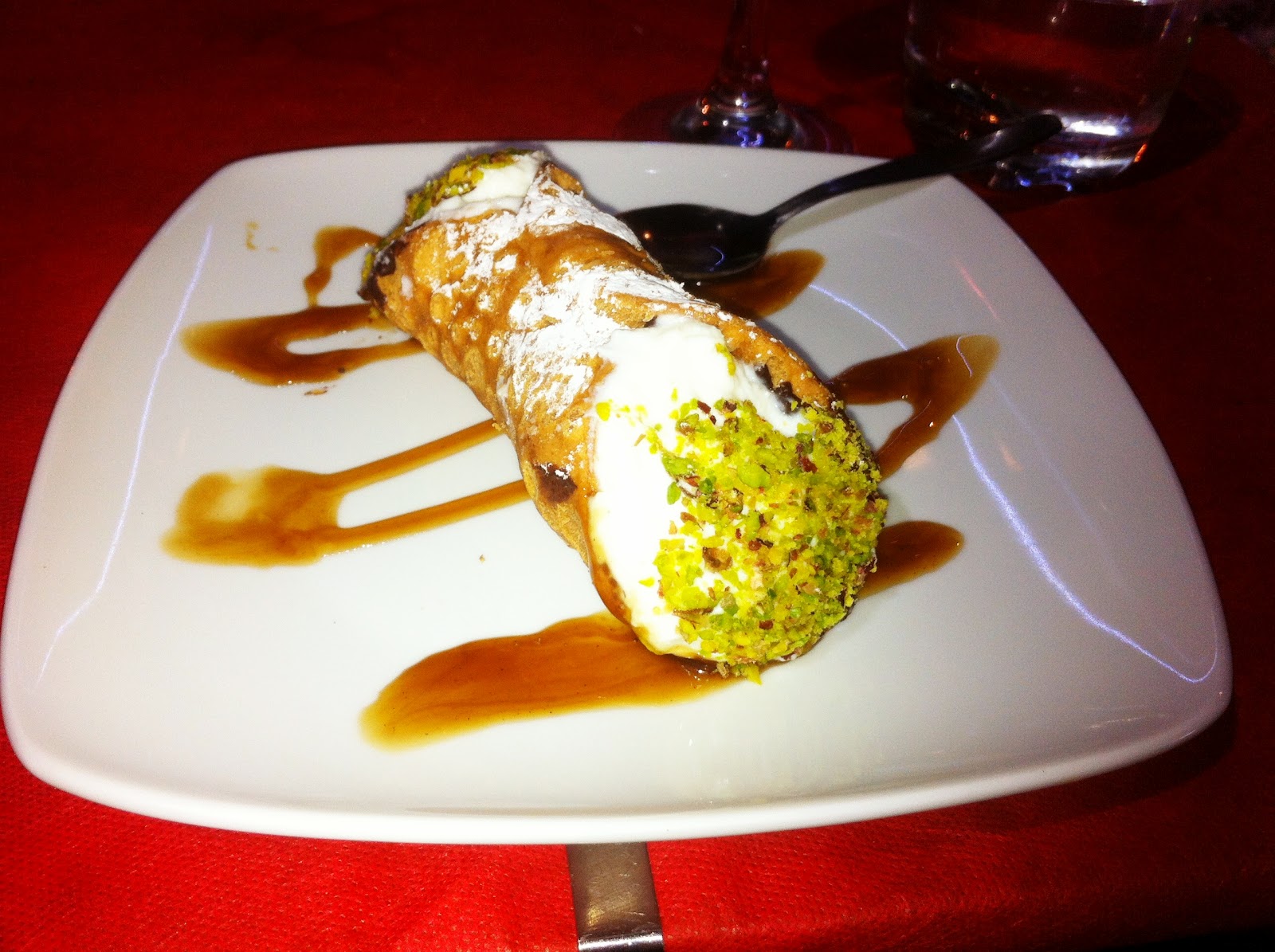
The desserts also delighted. Annoyingly, my every attempt to try the cassata was thwarted - time and again I was told sorry, it's off the menu. But I did scoff a few cannoli - deep-fried rolled pastry shells (a bit like a brandy snap), stuffed with fresh, sweetened ricotta and candied fruits then dipped in crushed pistachios. And the semifreddo of pistachio, marsala-soaked sponge and soft meringue was amazing.
There were many more memorable meals, too many to post here. Naturally I came home with food - a large hunk of salted ricotta, a lump of coppa, a jar of pistachio cream, bottles of limoncello and fennel liqueur, and a basket of these beautiful marzipan fruits...
Lastly, I've just found this lovely blog on Sicilian food and I'm enjoying dipping into the recipes and learning even more about the food culture there.

Tuesday, 26 June 2012

Aubergine Howard

Many years ago I cooked professionally at a long-gone restaurant in Leeds - the Wharfe Street Vegetarian Café. Before it closed, the owners published a cookbook of the same name, full of many of the recipes they'd served up over the years. I lost my copy only a couple of years later after lending it to someone and, inevitably, it went out of print. I spent a couple of decades looking for a replacement but a friend recently tracked a copy down for me, so I've had a delightful trip down memory lane.

This original recipe, Aubergine Jamaica, was an exotic sort of moussaka, with the sliced aubergines layered with potatoes, celery and mushrooms and the spicy coconut sauce inspired by both Caribbean and Sri Lankan food. I've stripped it right back, ousting the potatoes and the rest and substituting peppers. I've tinkered quite a lot with the sauce too, changing most of the spices. I've renamed this incarnation for my book-hunting friend.

What you need:
About 250g baby aubergines
A large red pepper
Half a block creamed coconut (about 100g)
Tahini
1 small red chilli, finely chopped, or 2tsp "lazy" chillies from a jar
1/2 inch grated fresh ginger root
1 heaped tsp allspice
1/4tsp paprika
1/4tsp celery salt
Flaked almonds

What to do: 
Trim the stalks off the aubergines then halve, or even quarter them depending on their size. Put them in a small casserole dish. Deseed the pepper and dice it. Scatter over the aubergines.

Make the sauce. Put the creamed coconut in a pan with 1/2 pint (300ml) boiling water, a heaped tablespoon of tahini and all the spices. Warm it over a low hob, stirring while everything blends together and creamed coconut has fully melted. Don't let it boil. Taste to check the seasoning and adjust the spices and salt to suit. Pour the sauce over the aubergines, cover it with a lid and bake for 45 minutes at 200C. Check it during cooking to ensure it's not drying out - top it up with a little boiling water if you need to.

Take the lid off and scatter over some flaked almonds then pop back in the oven for 15 minutes more.

Cook's tips: 
Don't be alarmed at the amount of aubergines - they will shrink right down during cooking.

Do add more heat with chilli and ginger if you like things hotter - the coconut and tahini can absorb quite a lot of spices before their flavours become masked. Check for salt too - aubergines love salt and this is one dish where I'd add more than I usually do. Just add a pinch at a time and taste in between.

For a less calorific sauce, use half a can of low-fat coconut milk instead of creamed coconut.

If you want carbs alongside, rice is the best partner.

Tuesday, 6 March 2012

Ratatouille

For such a simple dish, there's been an awful lot of hoohah written about how to make ratatouille - whole columns on which order to add the ingredients, or whether to cook them separately then bring them together, or if it's acceptable to use an Italian olive oil in this quintessentially French dish...

Personally, I don't think it matters much. I prefer to cook everything together because I think the ingredients should get to know each other in the pan rather than on the plate. And besides, life's too short to have five pans to wash up instead of one. I use the olive oil to hand - as long as it's good quality I don't care if it was pressed in Outer Mongolia.

What does matter to me are having good quality fresh ingredients, nothing wrinkly or tired-looking. The tomatoes matter most of all - a good tomato needs sunshine to have flavour, which means it needs to come from a hot country where it was grown outside in soil. I never, ever buy Dutch or Belgian tomatoes as they are grown in vast sheds under artificial lighting and rooted in water. They don't see earth or fresh air and they taste of nothing. I buy British in season and the rest of the year I only buy Spanish or Moroccan or whatever, as long as it's had sun.

On the basis that it is almost impossible to make one portion of ratatouille, this makes two generous ones, or even three if you dish it up alongside meat and carbs. And besides, ratatouille is one of those dishes that often tastes better next day...

What you need:
1 onion
4-6 medium size tomatoes
2 small courgettes
1 small aubergine, or 5-6 baby ones
1 red pepper
1 green pepper
A handful button mushrooms (optional)
2-3 cloves of garlic
Herbes de Provence or a bouquet garni
A bay leaf
Olive oil

What to do:
Heat a very generous amount of olive oil in a heavy pan on a moderate heat. Prepare the veg - cut the onion into wedges, the peppers into wide strips, the tomatoes into quarters, the courgettes into thick rounds and the aubergine into chunks (you can leave baby ones whole, or halve them). Peel and crush the garlic.

Sauté the onion and garlic until they are soft and the onion turns translucent. Add the tomatoes, peppers, aubergines and a pinch of the herbs, stir through, turn the heat down a notch and let everything stew gently for 20 minutes. Add the courgettes to the pan, stir through again and let stew for another 10-15 minutes. If you're including mushrooms, this is the time to add them. Season to taste and dish up. 


Cook's tips:
Ratatouille should not only look glossy and luscious, it should be unctuous too. If it's watery, it's not right. That's why it's important to turn the heat down and cook it slowly - if the hob's too hot the vegetables will boil and leach water. They will also break up too much. Don't put a lid on - let the water evaporate during cooking. This is another reason not to use hydroponic tomatoes as their water content is ridiculously high. It's also why I add the courgettes a bit later as they can turn soggy very quickly once they are cooked.

More on tomatoes - a punnet of cherry tomatoes or the baby plum type also work well in ratatouille.

Mushrooms have no place in a classic ratatouille but are a useful and acceptable extra to pad it out, especially if you're vegetarian and won't be having any meat on the side.

Grilled meats make a good accompaniment for carnivores - a lamb chop or two, sausages of some sort, or even a steak. Grilled or roasted fish is good too.

If you want carbs, rice, grains such as cous-cous, bulgur or quinoa, or a noodly pasta such as tagliatelle are all a good match. Or mop up the juices with some crusty bread.

Thursday, 20 October 2011

Baharat chicken with roasted aubergines

I'm a big fan of just chucking ingredients into a roasting tin and seeing what happens. Partly because I like roasts and as someone who lives alone, it's a good substitute for a Sunday roast with everyone gathered round the table. But also because if you have the time to cook something for an hour, it's a very simple way to cook - once you've prepped everything you have a spare hour to spend on other things while your home fills with cooking fragrances. I'm fortunate that working from home means I can cook this way on a week night - if I were a commuter arriving home starving at the end of a long day, I'd almost certainly want something on the table within half an hour.

This dish is so ridiculously simple, and tasty, that there's almost nothing to do once it's in the oven apart from check it occasionally.


What you need: 
A couple of small chicken joints (thighs or drumsticks)
2 shallots
1 bell pepper deseeded and quartered
A handful of baby aubergines
Olive oil
Baharat
1/2 lemon (optional)

What to do:
Heat the oven to 190C. In a roasting tin coat the chicken, peeled shallots, pepper and aubergines in the olive oil and mix well. Sprinkle over a light dusting of baharat. Pop in the oven for about an hour. Halfway through, turn the ingredients over to brown them evenly.


Cook's tips:
Baharat is a wonderfully fragrant spice mix used across the Middle East. The ingredients can vary but it usually contains coriander, cloves, cinnamon, black pepper, cumin and cardamom. Sometimes it will also have nutmeg, chilli or cayenne pepper. You can find it in some supermarkets or ethnic grocers. Beware - it can be pungent and strong so go easy with it until you've got used to cooking with it. If you can't find it, the Moroccan ras el hanout is easier to find in the shops and makes a good, slightly less hot substitute.

Baby aubergines are easiest and cheapest to find in an ethnic greengrocer's. The flavour, in my opinion, is more concentrated than in the full-size variety, and roasting them whole or halved is a really delicious way to appreciate their taste. The skins will crisp up somewhat, while the flesh inside will melt into a creamy mush. If you opt for the larger type, one medium one will be plenty - cut it into generous chunks and go easy on the oil as aubergines will soak up everything you throw at them.

I often add a couple of lemon quarters to this kind of roasted dish because I like the tartness, but roasting lemons also brings out a concentrated sweetness that goes well with most kinds of meat and the kind of Mediterranean vegetables I like to use.